
Do The Right Thing

Hi,
I’ll cut right to the chase. The revolution we wanted is here. It really feels like we’re at the final push for abolition. And I’ve been thinking all week about how photography and video evidence were the missing link to what we’ve been talking about for months, years, decades, centuries…. the trust in photography and video as an all-seeing truth-telling medium has led up to this very moment. It’s spurring a nationwide, reignited movement.
It seems silly to put out a film review newsletter in the middle of a global movement for black lives, but I firmly believe that films help us see the world differently - they help our imaginations see what life could be like without the oppressive systems we live within. Or they help illuminate experiences that are different from our own, which usually is what motivates us to align with each other in the struggle. Personal appeals, stories, and evidence are what matter in changing minds.
So, I decided to revisit one of the films that started that change:
Do The Right Thing (1989, dir Spike Lee)
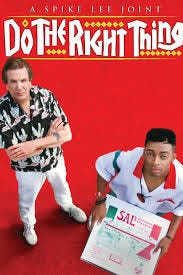
Spike Lee’s follow up film to She’s Gotta Have It chronicles a 24 hour hot-as-hell day and night in Bed Stuy, Brooklyn. For those of us who live/have lived in NYC, we know this summer day. You wake up sweating, sticky, and you can smell the garbage coming up from the street. Neighbors are already parked on their stoops or on the corner by 9 am. We meet everyone in the neighborhood slowly - there’s the elder queen of the block hanging out of her window, there’s the mayor of the block, there’s the posse of teens, there’s the white gentrifier guy, there’s the guy selling shaved ice, there’s the Italian owned pizza joint central to the story, and there’s Mookie. Played by Spike himself, Mookie is the delivery man for Sal’s pizzeria. He acts as our guide through the neighborhood as we accompany him on his deliveries throughout the day. We learn the complicated tensions of the block: the Mayor is too drunk but he’s everyone’s leader, Mookie has a kid and a girlfriend that he never sees, the three old dudes on the corner always have something to say but never really do anything, the police come in and harass kids playing in the street.
The central driving tension in the film comes from the relationship between Sal, his sons, Mookie, and a couple community members. Tensions are already high between Sal and his black customers, but they begin to rise as Buggin’ Out, Mookie’s friend, begins questioning Sal about his “wall of fame” - and why no Black people are present on it. Clearly there should be some black folks on the wall, this is a black neighborhood! But Sal insists that because it is his establishment there will be only Italian people on the wall. Buggin’ Out begins to honor his namesake, and starts enough of a scene to get kicked out of the restaurant. He then rallies enough support, with the help of a few friends also micro-aggressed by Sal, to come back at the end of the night and let him know they are not going to stand for that any longer.
I won’t tell you everything that happens - but it feels pertinent to discuss the climax of the film.
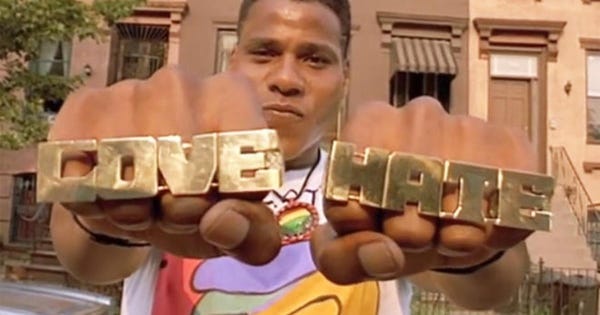
During our time on the block, we meet Radio Raheem, a beautiful, stoic man who carries a boom box playing Public Enemy’s Fight the Power. See also: Raheem’s speech about the story of love and hate. Earlier in the film, Radio Raheem and Sal get into a fight about the volume of his music. When Buggin’ Out returns at the end of the day to confront Sal - Radio Raheem is there. He starts playing Fight the Power. Spike Lee’s ubiquitous wide angle lens closeup shot of the radio fills our vision. Sal snaps, pulls a bat out from behind the counter and smashes the radio with way more force than he should. There’s a beat. Everyone is stunned - the tape squeals, slows and stops. Then, an uproar. Radio Raheem pulls Sal over the counter like a rag doll, and starts fighting him. As you can imagine, the entire block comes out as the fight spills out of the pizzeria and onto the street. Ironically, just moments before this, it felt like so many tensions were easing. But, as the commotion ensues, the police arrive and pull Radio Raheem off of Sal, and kill him by strangling him with a baton. The last moments of his life are marked by the dangling of his feet - a presence so majestic and large suddenly childlike and diminutive under the hands of the police. Radio Raheem’s body is thrown into the back of a patrol car.
As a viewer, you’re stunned by how quickly a fight about pictures on a wall and the volume of music turned deadly. You suddenly recall all of the murders of black people by the hands of the police. And how they all escalated quickly like this. A hot day, a mistaken apartment, music that’s too loud, a “counterfeit” $20 bill, all the stories we’re too familiar with at this point.
Another beat. Sal tries to defend himself, the block goes up. Mookie, blank-faced and silent, walks to a trash can. He dumps the trash out of the can and walks with increasing speed to the storefront. Then, wordlessly and with ease, he throws it straight through the windows of the storefront - and the crowd rushes in. Fires are set. Soda machines destroyed. Money taken. The police arrive and the fire department starts spraying folks with water hoses. And we fade to black on the anguish of the oldest woman on the block, and Mookie, sitting on the curb.
This film is a masterpiece because it unflinchingly tells the story of a block and its faults and problems and joys and frustrations. It subtly engages us with the age old question posed by Malcom X: The Ballot or the Bullet. Non-Violence or Violence. But what we know is that, even in times of conflict, the police’s entry into the situation can and will escalate things to violence. At the end of this film, Sal’s whole life is burned to the ground, but that loss pales in comparison to the loss of a life. We don’t really care about the property damage, and at his core, Sal doesn’t either (even though he’s devastated). Lee makes a painstaking effort to point out every character’s flaws but also each of their talents. We learn their hopes, their fears, their jokes, their anger, their bodies, their style, what they care about, who is who’s sister or cousin, what they hate, what they love. We spend so much time with these people that when the film finally reaches its final conflict, we feel like one of the family. Radio Raheem’s death hits us like he was our neighbor, our friend. Like we were waiting to hear the boom of music coming down the block. And inevitably, this is what gets through to us about his death - that we can see statistics all we want but what it comes down to is inexcusable loss of Black life. A life that was complicated, but perfect. A life that brought a message to our community. A life that we needed to have with us. And so, we want to rise up in anger with the crowd. And we know Mookie did the right thing.
10/10
I write this to you with pain and joy in my heart. I write this to you knowing that the future is going to be a different world and I’m so excited to join you all there. I am so proud of my friends for being in the streets every fucking night. I am so proud of seeing so many queer folks during “pride month” doing intense organizing and holding it the fuck down. We know that the violence we’re seeing was and always has been instigated by the police. It’s being proven over and over every day. Another world is finally on the horizon and I am so proud of my friends doing medic support, getting tear gassed and turning around and flushing someone else’s eyes, delivering supplies to folks, reaching out to people in their lives, doing the work, doing research on orgs and racist origins of our institutions, disseminating information, challenging themselves to see a world without police, and really really believing in it. We’re so close I can almost taste it and every day I wake up and my heart is so full of PRIDE and joy. I believe that we will win. I grieve every day for the lives we’ve lost and we won’t stop until we get a better world for black folks, which will destroy the myth of whiteness and create a better world for every single one of us.
IN LOVE AND RAGE,
Ronika
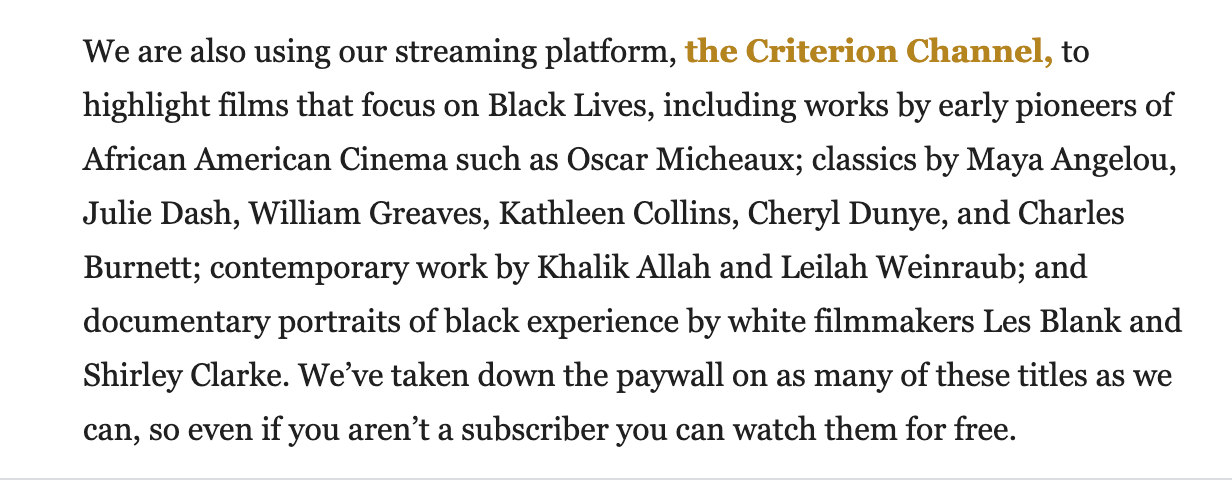
ps, criterion is offering a bunch of films by black directors and about black directors for FREE! see below:
pps: if you like what you read, feel free to throw a tip to me via venmo: ronika-mcclain